Date: 2026-11-10 hits: 108
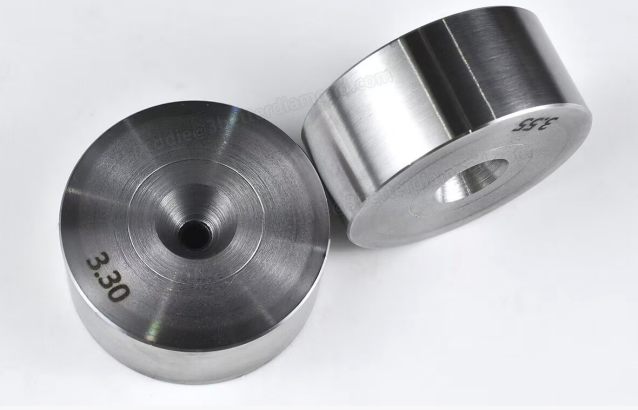
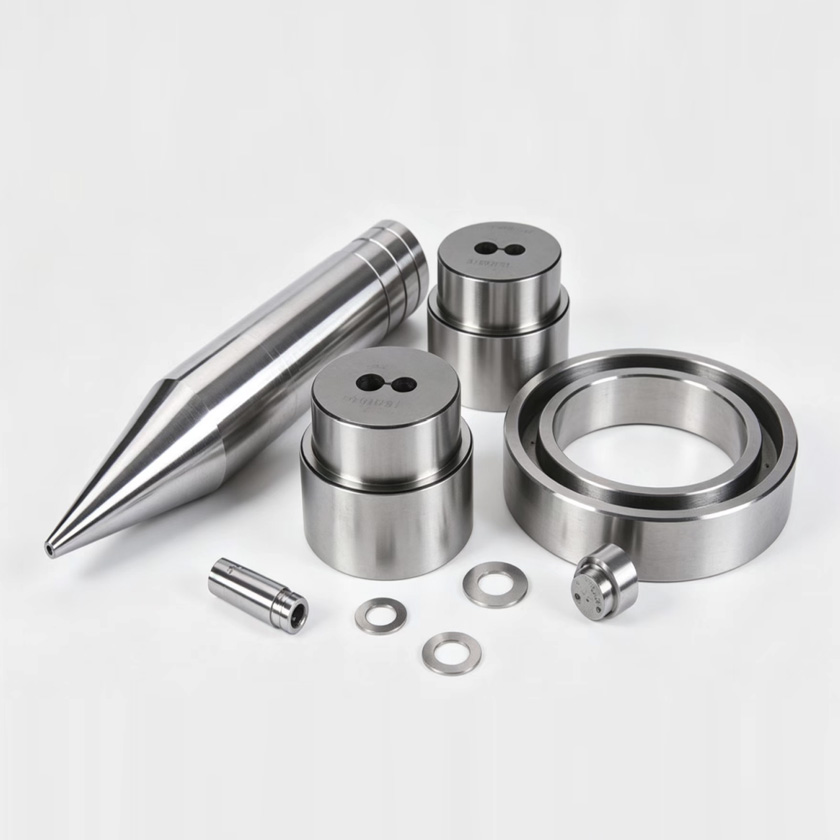
The substrate is generally YG6/YG8 hard alloy (tungsten steel), and the inner hole working surface is coated with nanocrystalline diamond layer (HFCVD hot filament CVD) to be used for copper/aluminum conductor stranded wires and compression molding, replacing the ordinary tungsten steel stranded wire molds.
1. Substrate Machining
Select YG6 / YG8 tungsten carbide blank. Carry out rough machining, drilling and internal grinding to form the complete die profile (inlet zone, compression zone, sizing zone and exit zone). Precision grinding is performed to guarantee the contour, concentricity and basic surface finish of inner bore.
2. Pre-treatment
Clean and etch the surface to remove oil stains and impurities, improving bonding force between diamond coating and carbide substrate to avoid coating peeling off.
3. HFCVD Deposition of Nano grain Diamond Coating
Inside vacuum deposition furnace, feed carbon containing gas. Excitation by hot filament grows nano grain diamond coating (grain size approx. 20-50 nm) on the inner working surface. Control deposition temperature, pressure and gas ratio to adjust coating thickness and grain size.
4. Post-treatment, Fine Polishing & Inspection
Fine polish the inner bore after coating deposition. Carry out tests for coating adhesion, surface roughness, aperture dimension and concentricity. Calibrate dimension, mark parts and finish final inspection before warehouse entry.
5. Unlike PCD (polycrystalline diamond) dies, which are made from a sintered diamond blank, nano-stranded dies consist of a tungsten carbide substrate with a nano-diamond coating on the inner bore。
Core Advantages
1. Significantly extended service life
Wear resistance is far higher than that of ordinary cemented carbide stranding dies. In many applications, service life can reach 10 times or even dozens of times that of ordinary tungsten carbide dies, reducing the frequency of die changes, die-change downtime, and die procurement costs.
2. Stable stranding outer diameter, high dimensional accuracy, and copper/aluminum savings
The coating has a low coefficient of friction and high wear resistance, so the bore is less likely to enlarge during long production runs. The stranding outer diameter fluctuates very little, and conductor compaction is more uniform, saving 2%–3% of copper and aluminum raw materials. Cable manufacturers highly value this, with clear cost-saving benefits.
3. Better conductor surface quality, fewer burrs, and improved electrical performance
The inner bore surface is highly smooth, resulting in fewer burrs and scratches on the stranding surface. This reduces corona discharge and partial discharge (PD), improves voltage withstand and PD pass rates, and is suitable for medium- and high-voltage cables and high-quality conductors.
4. Low friction resistance, higher stranding speed, and energy savings
The diamond coating has a low coefficient of friction, reducing stranding traction resistance. Speed can be appropriately increased, energy consumption reduced, and the efficiency of the entire stranding production line improved.
5. Significantly reduced copper/aluminum adhesion
Metal adhesion to the die is less likely, reducing conductor surface scratches and metal powder, and reducing the frequency of die cleaning.
6. Lower overall O&M costs
Although the unit price of the die is higher than that of ordinary tungsten carbide dies, its long service life, less downtime, raw material savings, and low defect rate often result in lower overall costs.
✅Much longer service life than standard carbide stranding dies
✅Stable finished conductor outer diameter, saving copper & aluminum material
✅Smooth conductor surface, less burrs, improved PD / voltage-withstanding performance
✅Low friction, higher stranding speed & lower power consumption